Satellite Networking, Green Computing, AI, Graph Theory卫星网络、绿色计算、人工智能、图论
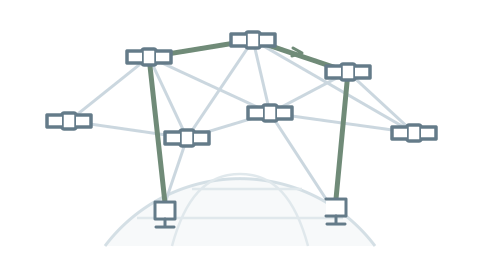
My main focus is mega-LEO satellite networking: designing simple, effective algorithms for the evolving needs of users and network operators in the 6G and AI era. I aim for methods that could be evaluated and adapted for constellations such as Starlink and Qianfan, with the longer-term goal of supporting useful, widely accessible services. My broader interests include graph theory, the P versus NP question, green computing for AI, and applications of AI to cryptography, biology and medicine. My long-term hope is to contribute to research of lasting benefit to humanity, inspired by the Nobel-recognized work of Charles K. Kao and Tu Youyou.
我的主要研究方向是巨型 LEO 卫星互联网组网。立足 6G 与人工智能时代通信基础设施领域的关键技术需求与瓶颈,开展卫星组网、绿色计算与人工智能方向的研究,设计简单、高效、可用、易实现、易部署的技术方法,推动其在 Starlink、千帆等巨型星座中的应用,让卫星通信连接全球、走进千家万户,服务于人们的日常生活。同时关注图论、P 与 NP 这一世界难题、面向人工智能的绿色计算,以及人工智能在密码学、生命科学与医学中的应用。长远而言,我希望参与能够持续造福社会的研究,并从高锟、屠呦呦等诺贝尔奖得主的工作中汲取启发。
I use mathematical optimization, graph theory and experiments to identify useful structure, develop algorithms and test new ideas. I hope to contribute rigorous research that is simple in design, effective in practice and useful beyond the laboratory.
I welcome self-motivated students and collaborators who enjoy patient, careful work on concrete research challenges, as well as discussions and joint projects with industry teams addressing practical needs. Contact: bqguo@stu.xidian.edu.cn.
Enhancing Mega-Satellite Networks with Generative Semantic Communication: A Networking Perspective [IEEE]
IEEE Wireless Communications2025
(中科院二区 · IF: 13.4)
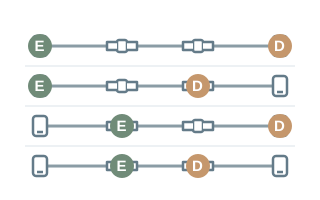
Generative semantic communication for satellite networks and a fundamental model-placement law for multi-hop semantic communication.
研究卫星生成式语义通信与多跳语义通信的模型部署基本定律。
Authors & details作者与详情
Fundamental model-placement law for multi-hop semantic communication: placing the semantic encoder near the source and the decoder near the destination can reduce aggregate bandwidth use, while routing detours can offset this benefit.
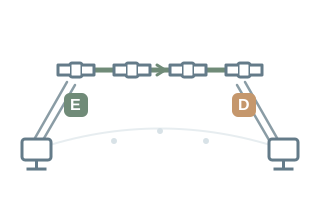
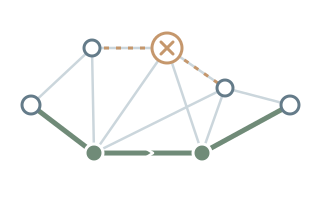
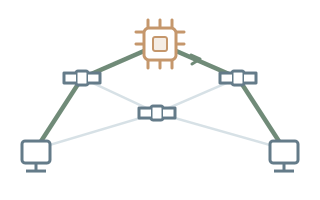
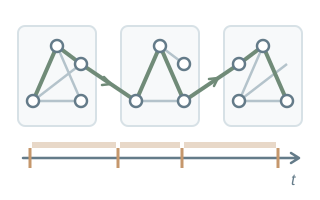
I study networking algorithm design for large, moving constellations: routing, resilience, semantic communication and in-orbit computing. The aim is to meet service requirements with manageable implementation costs. Related work has appeared in IEEE TMC, Wireless Communications, TCOM and TVT, and at several conferences.
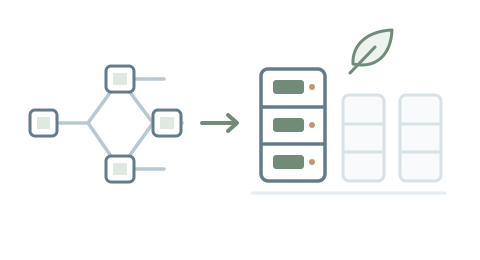
Resource packing in data centers, workflow scheduling and multi-step language-model inference. I am interested in using fewer computing resources to meet a given service requirement, and in understanding the trade-offs between energy, latency and utilization.
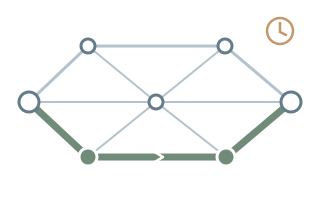
An exploratory interest in computational complexity, grounded in specific graph and NP-hard scheduling problems. I study exact, smart, and optimal methods, and how AI and mathematical optimization may help reveal useful problem structure.
Exploring how learning-based methods can support the analysis and design of cryptographic systems, with attention to mathematical guarantees and reproducible evaluation.
探索学习方法如何辅助密码系统的分析与设计,重视数学保证和可复现的评估。
Natural and life sciences自然科学与生命科学
I also explore questions in the natural and life sciences, learning across fields and considering how new observations can inform useful models and methods.
持续关注自然科学与生命科学中的问题,从不同领域的新发现中学习,探索有用的模型与方法。
Professional Highlights专业经历
Publications
Published or accepted more than 20 IEEE journal and conference papers, including 15 first-author and 2 corresponding-author papers. Venues include IEEE TMC, TCOM, TVT, Wireless Communications, Network and Wireless Communications Letters, as well as ICC, GLOBECOM and PIMRC.
Research projects
Contributed to five nationally funded projects on data-center networking, temporal graphs and satellite networks. Served as PI of a deterministic resource-slicing project and co-PI of a non-stationary traffic-modeling project, supported by university research funds.
Teaching & mentoring
Teaching assistant for three undergraduate courses. Assisted in supervising graduate-student research leading to papers in IEEE Transactions on Wireless Communications (two papers), IEEE Transactions on Vehicular Technology, IEEE ICC and Optics Express, among other publications.
Professional service
Completed more than 70 journal reviews, including for IEEE Communications Magazine, Internet of Things Journal, Network and several IEEE Transactions journals. Technical program committee service for IEEE ICC, GLOBECOM and VTC; session chair at IEEE MetaCom 2024. Youth Editorial Board member, China Communications (2026–2028).
Membership
IEEE Senior Member; member of the IEEE Communications Society.
Standards contributions
Contributed to two CCSA association standards on data-center network energy-efficiency measurement and hybrid wired/wireless networking: T/CCSA 370-2022 and T/CCSA 369-2022.
Patent
Co-inventor of a color-vision test chart synthesis method granted in China in 2023: CN111429547B.
Research exchange
I maintain close academic connections and collaborations with researchers and teams at the Singapore University of Technology and Design, National University of Singapore, Nanyang Technological University, Queen’s University Belfast, University of Surrey, University of Houston, RMIT University, University of Jyväskylä, Xidian University and Zhejiang University.
Students with curiosity, initiative and a sustained interest in research are welcome to get in touch. Where there is a good research fit, I can offer guidance and help with introductions or recommendations for graduate study at institutions such as NTU, Queen’s University Belfast, SUTD, the University of Houston, Harbin Institute of Technology, Hunan University and Xidian University. Contact: bqguo@stu.xidian.edu.cn.
论文工作
已发表或录用 IEEE 期刊与会议论文 20 余篇,其中第一作者 15 篇、通讯作者 2 篇。
项目研究
参与 5 项国家科研项目,并分别担任 2 项校级研究项目的 PI 与 co-PI,研究涉及数据中心、时变图与卫星网络。
Binquan~Guo,~\IEEEmembership{Senior Member, IEEE}
\thanks{Binquan~Guo is with the Pillar of Information Systems Technology and Design, Singapore University of Technology and Design, Singapore 487372 (e-mail: bqguo@stu.xidian.edu.cn).}
Journal biography期刊论文简介
\begin{IEEEbiography}[{\includegraphics[width=1in,height=1.25in,clip,keepaspectratio]{binquan_guo.eps}}]{Binquan Guo}
(Senior Member, IEEE) received the B.S., M.S., and Ph.D. degrees in telecommunication engineering from Xidian University, Xi'an, China, in 2017, 2020, and 2025, respectively. He is currently with the Pillar of Information Systems Technology and Design, Singapore University of Technology and Design, Singapore. His research interests include satellite networking, green computing, graph theory, AI, semantic communication, routing and scheduling.
\end{IEEEbiography}
Magazine biographyMagazine 论文简介
\indent \textbf{Binquan Guo} (bqguo@stu.xidian.edu.cn) (Senior Member, IEEE) received the B.S., M.S., and Ph.D. degrees in telecommunication engineering from Xidian University, Xi'an, China, in 2017, 2020, and 2025, respectively. He is currently with the Pillar of Information Systems Technology and Design, Singapore University of Technology and Design, Singapore. His research interests include satellite networking, green computing, semantic communication, graph theory, AI, routing and scheduling.
Funding acknowledgement资助致谢
\thanks{This work is supported in part by the National Natural Science Foundation of China under Grant 62171456, and in part by A*STAR under its IAF-ICP (H25-MCP3438).}
EDAS accountEDAS 账号
EDAS: Binquan Guo
13468897661@163.com
Reviewer details审稿人信息
Binquan Guo
bqguo@stu.xidian.edu.cn
binquan_guo@sutd.edu.sg
Xidian University
or Singapore University of Technology and Design
Copy a citation, or select its title to view the BibTeX.可逐条复制,点击论文标题可展开 BibTeX。
Enabling Real-Time Computing and Transmission Services in Large-Scale LEO Satellite NetworksIEEE Transactions on Vehicular Technology · 2025
@article{guo2025enabling,
  author = {Guo, Binquan and Zhang, Zhou and Atapattu, Saman and Pan, Miao and Yan, Ye and Xiong, Zehui and Li, Hongyan},
  title = {Enabling Real-Time Computing and Transmission Services in Large-Scale {LEO} Satellite Networks},
  journal = {IEEE Transactions on Vehicular Technology},
  year = {2025},
  month = {Aug.},
  volume = {74},
  number = {8},
  pages = {12813--12828},
  doi = {10.1109/TVT.2025.3550806}
}
Resilience of Mega-Satellite Constellations: How Node Failures Impact Inter-Satellite Networking Over Time?IEEE Transactions on Communications · 2025
@article{guo2025resilience,
  author = {Guo, Binquan and Xiong, Zehui and Zhang, Zhou and Li, Baosheng and Niyato, Dusit and Yuen, Chau and Han, Zhu},
  title = {Resilience of Mega-Satellite Constellations: How Node Failures Impact Inter-Satellite Networking Over Time?},
  journal = {IEEE Transactions on Communications},
  year = {2025},
  month = {Dec.},
  volume = {73},
  number = {12},
  pages = {15705--15721},
  doi = {10.1109/TCOMM.2025.3610221}
}
Lightweight Maximum-Capacity Path Selection for Delay-Sensitive Applications in Large-Scale LEO Satellite NetworksIEEE Transactions on Vehicular Technology · 2025
@article{guo2024lightweight,
  author = {Guo, Binquan and Xiong, Zehui and Han, Zhu and Yuen, Chau and Sun, Sumei},
  title = {Lightweight Maximum-Capacity Path Selection for Delay-Sensitive Applications in Large-Scale {LEO} Satellite Networks},
  journal = {IEEE Transactions on Vehicular Technology},
  year = {2025},
  month = {Apr.},
  volume = {74},
  number = {4},
  pages = {6573--6585},
  doi = {10.1109/TVT.2024.3516779}
}
Lightweight Semantic Communication-Compliant Shortest Path Selection in Large-Scale LEO Satellite NetworksIEEE Transactions on Mobile Computing · 2026
@article{guo2026lightweight,
  author = {Guo, Binquan and Xiong, Zehui and Zhang, Zhou and Yang, Qianqian and Li, Baosheng and Niyato, Dusit and Guizani, Mohsen and Han, Zhu},
  title = {Lightweight Semantic Communication-Compliant Shortest Path Selection in Large-Scale {LEO} Satellite Networks},
  journal = {IEEE Transactions on Mobile Computing},
  year = {2026},
  month = {Sep.},
  volume = {25},
  number = {9},
  pages = {13880--13897},
  doi = {10.1109/TMC.2026.3675010}
}
Enhancing Mega-Satellite Networks With Generative Semantic Communication: A Networking PerspectiveIEEE Wireless Communications · 2026
@article{guo2025enhancing,
  author = {Guo, Binquan and Yang, Wanting and Xiong, Zehui and Zhang, Zhou and Li, Baosheng and Han, Zhu and Tafazolli, Rahim and Quek, Tony Q. S.},
  title = {Enhancing Mega-Satellite Networks With Generative Semantic Communication: A Networking Perspective},
  journal = {IEEE Wireless Communications},
  year = {2026},
  month = {Apr.},
  volume = {33},
  number = {2},
  pages = {226--234},
  doi = {10.1109/MWC.2025.3596938}
}
Enhanced Time Discretization for Temporal Graph-Based Continuous Service Provisioning in Large-Scale Satellite NetworksIEEE Wireless Communications Letters · 2024
@article{guo2024enhanced,
  author = {Guo, Binquan and Chang, Zheng and Han, Zhu and Xiong, Zehui},
  title = {Enhanced Time Discretization for Temporal Graph-Based Continuous Service Provisioning in Large-Scale Satellite Networks},
  journal = {IEEE Wireless Communications Letters},
  year = {2024},
  month = {Sep.},
  volume = {13},
  number = {9},
  pages = {2625--2629},
  doi = {10.1109/LWC.2024.3434990}
}
Network Slicing Strategy for Real-Time Applications in Large-Scale Satellite Networks With Heterogeneous TransceiversIEEE Wireless Communications Letters · 2024
@article{guo2024network,
  author = {Guo, Binquan and Chang, Zheng and Han, Zhu and Yang, Wanting and Xiong, Zehui},
  title = {Network Slicing Strategy for Real-Time Applications in Large-Scale Satellite Networks With Heterogeneous Transceivers},
  journal = {IEEE Wireless Communications Letters},
  year = {2024},
  month = {Aug.},
  volume = {13},
  number = {8},
  pages = {2195--2199},
  doi = {10.1109/LWC.2024.3406369}
}
Time-Deterministic Networking for Satellite-Based Internet-of-Things Services: Architecture, Key Technologies, and Future DirectionsIEEE Network · 2024
@article{guo2024time,
  author = {Hu, Yun and Guo, Binquan and Yang, Chungang and Han, Zhu},
  title = {Time-Deterministic Networking for Satellite-Based Internet-of-Things Services: Architecture, Key Technologies, and Future Directions},
  journal = {IEEE Network},
  year = {2024},
  month = {Jul.},
  volume = {38},
  number = {4},
  pages = {111--118},
  doi = {10.1109/MNET.2024.3380073}
}
Online Network Slicing for Real Time Applications in Large-scale Satellite NetworksICC 2023 - IEEE International Conference on Communications · 2023
@inproceedings{guo2023online,
  author = {Guo, Binquan and Li, Hongyan and Zhang, Zhou and Yan, Ye},
  title = {Online Network Slicing for Real Time Applications in Large-scale Satellite Networks},
  booktitle = {ICC 2023 - IEEE International Conference on Communications},
  year = {2023},
  month = {May--Jun.},
  pages = {5564--5569},
  doi = {10.1109/ICC45041.2023.10279431},
  address = {Rome, Italy}
}
Multi-Path Transmission of Real-Time Remote Sensing Data via Heterogeneous LEO Inter-Satellite-Links2024 IEEE 21st International Conference on Mobile Ad-Hoc and Smart Systems (MASS) · 2024
@inproceedings{guo2024multi,
  author = {Guo, Binquan and Xiong, Zehui and Niyato, Dusit and Mao, Shiwen and Han, Zhu},
  title = {Multi-Path Transmission of Real-Time Remote Sensing Data via Heterogeneous {LEO} Inter-Satellite-Links},
  booktitle = {2024 IEEE 21st International Conference on Mobile Ad-Hoc and Smart Systems (MASS)},
  year = {2024},
  month = {Sep.},
  pages = {75--81},
  doi = {10.1109/MASS62177.2024.00021},
  address = {Seoul, Korea, Republic of}
}
Semantic Communication-Aware End-to-End Routing in Large-Scale LEO Satellite Networks2024 IEEE International Conference on Metaverse Computing, Networking, and Applications (MetaCom) · 2024
@inproceedings{guo2024semantic,
  author = {Guo, Binquan and Xiong, Zehui and Wang, Bo and Quek, Tony Q. S. and Han, Zhu},
  title = {Semantic Communication-Aware End-to-End Routing in Large-Scale {LEO} Satellite Networks},
  booktitle = {2024 IEEE International Conference on Metaverse Computing, Networking, and Applications (MetaCom)},
  year = {2024},
  month = {Aug.},
  pages = {137--142},
  doi = {10.1109/MetaCom62920.2024.00033},
  address = {Hong Kong, China}
}
Virtualized Computing and Communication Service Provision in Large-Scale Software Defined Satellite Networks2024 IEEE/CIC International Conference on Communications in China (ICCC) · 2024
@inproceedings{10681883,
  author = {Ding, Wei and Guo, Binquan and Xiong, Zehui},
  title = {Virtualized Computing and Communication Service Provision in Large-Scale Software Defined Satellite Networks},
  booktitle = {2024 IEEE/CIC International Conference on Communications in China (ICCC)},
  year = {2024},
  month = {Aug.},
  pages = {1157--1162},
  doi = {10.1109/ICCC62479.2024.10681883},
  address = {Hangzhou, China}
}
Spatio-Temporal Multi-View Based Short-Term Traffic Forecasting for Incomplete Time Series in LEO Satellite Networks2024 IEEE Wireless Communications and Networking Conference (WCNC) · 2024
@inproceedings{peng2024spatio,
  author = {Peng, Liang and Yan, Jie and Guo, Binquan and Wang, Xiaoxiang},
  title = {Spatio-Temporal Multi-View Based Short-Term Traffic Forecasting for Incomplete Time Series in {LEO} Satellite Networks},
  booktitle = {2024 IEEE Wireless Communications and Networking Conference (WCNC)},
  year = {2024},
  month = {Apr.},
  pages = {1--6},
  doi = {10.1109/WCNC57260.2024.10570573},
  address = {Dubai, United Arab Emirates}
}